Jenzabar SONIS 2024 Pell Processing Updates for 2024-2025 Award Year
Overview
Effective with the 2024-2025 Award Year, the Dept. of Education eliminated the use of the Pell Grant tables for awarding Pell, amongst other changes. Instead, information received by the institution on the via the Institutional Student Information Record (ISIR) file, the Student Aid Index (SAI), and enrollment intensity values will determine the amount of Pell a student can receive. The Pell Grant processes within Jenzabar SONIS have been updated to comply with the Dept. of Education's use of Pell Max, Pell Min, and Pell Intensity calculations.
Pell Processing Considerations
Due to the proscriptive nature of the Federal Pell Processing Guidelines, there is very little flexibility for institutional decisions. With that in mind, SONIS has been programmed to award and disburse Pell in compliance with the following guidance:
An ISIR must be present in SONIS to calculate and disburse the Pell.
The Student Aid Index (SAI) will be subtracted from the Max Pell amount, then rounded to the nearest $5.00, to get the Calculated Scheduled Award (CSA) for the recipient.
The FSA Rounding Rules for a Calculated Scheduled Award (CSA) are: if the CSA ends in 1 or 2, round down to 0; 3 or 4, round up to 5; 6 or 7, round down to 5; 8 or 9, round up to 0; 0 or 5, no rounding necessary.
If the Max Pell minus the SAI calculation results in a Scheduled Pell Award less than the Min Pell amount, the recipient is ineligible for Pell based on SAI. However, they may still be eligible for Min Pell if they meet the criteria described in Step 3 of the 2024-2024 Pell Eligibility and SAI Guide.
When using fractions, multiply first, then divide.
If the Scheduled Pell Award exceeds the Cost Of Attendance (COA), reduce the Scheduled Pell Award to COA. Do not round; truncate cents.
Enrollment Intensity is the percentage of full-time enrollment at which a student is enrolled, rounded to the nearest whole percent. For example, if full-time enrollment is 12 credit hours and the student is enrolled in 6 hours, the enrollment intensity would be 6 / 12 x 100% = 50%.
If a Pell recipient has multiple ISIRs in SONIS, regardless of whether an ISIR has been selected as the packaging ISIR, the more current ISIR information will be used to determine Pell award amounts.
Considerations if Using Post Transactions to Post Pell Awards
When processing Post Transactions for an AW T-code, where the award selected is Pell, the calculations are:
If the student's ISIR value for the Pell Max Indicator is not blank, the student qualifies for the Max Pell amount. This amount, divided by the number of Pell semesters identified in System Variables, should be pre-populated in the Amount field.
If the student's ISIR value for the Pell Min Indicator is not blank, the student qualifies for the Min Pell amount. This amount, divided by number of Pell semesters identified in System Variables should be pre-populated in the Amount field.
If the student's ISIR value for Children of Fallen Heroes (CFH) is 1 or 2, the student qualifies for the Max Pell amount. This amount, divided by the number of Pell semesters identified in System Variables should be pre-populated in the Amount field.
If the student's ISIR value for Iraq-Afghanistan Service Grant (IASG) is 1 or 2, the student qualifies for the Max Pell amount. This amount, divided by number of Pell semesters identified in System Variables, should be pre-populated in the Amount field.
If both the Max Pell Indicator and Min Pell Indicator for the student are blank, the CFH and/or IASG fields are not 1 or 2, AND the Pell Eligible flag is Y, then the Pell will be calculated and pre-populated as follows:
If the student is enrolled full-time, Max Pell minus SAI equals the amount of Pell the student is eligible for in the award year. Divide this amount by the number of Pell semesters identified in System Variables to determine the amount that will be pre-populated in the Amount field for each semester.
If the student is not enrolled full-time, Max Pell minus SAI equals the Pell award for the year. Calculate the ration of enrolled credits to full-time credits and multiply the resulting Pell award amount by that ratio. Divide the amount by the number of Pell semesters in System Variables to pre-populate the Amount field for the semester. (This is the Pell Intensity calculation.)
Pell Intensity Example:
Max Pell - SAI = $5,000 for the year/$2,500 per semester
The student is enrolled in 6 credits; 12 credits is full-time.
6 / 12 = 50%. $2,500 x 50% = $1,250.
$1,250 would be populated in the Post Transactions Amount field.
Setup
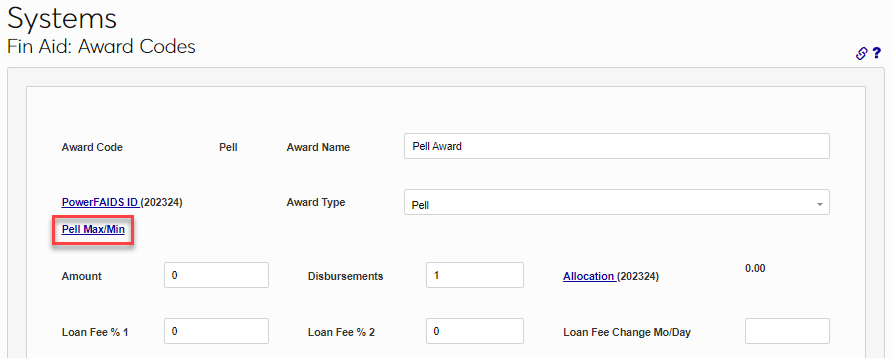
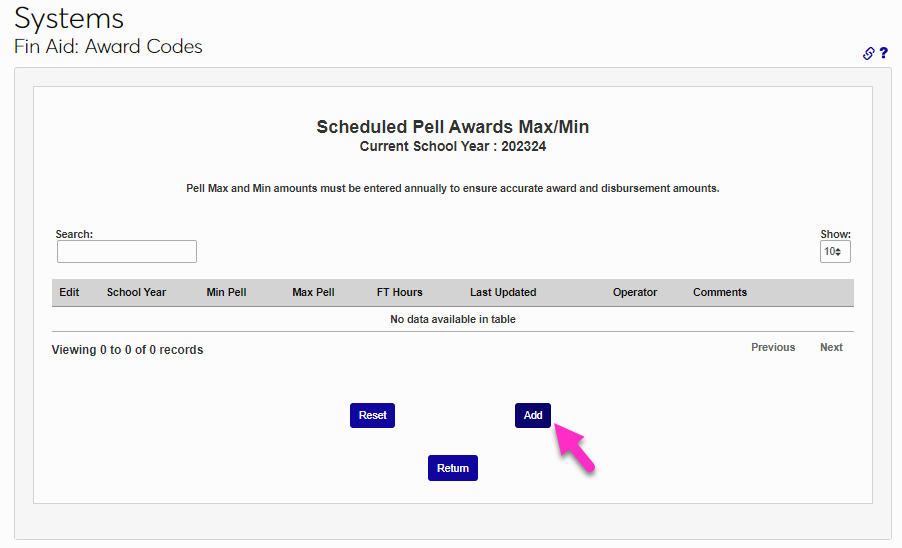
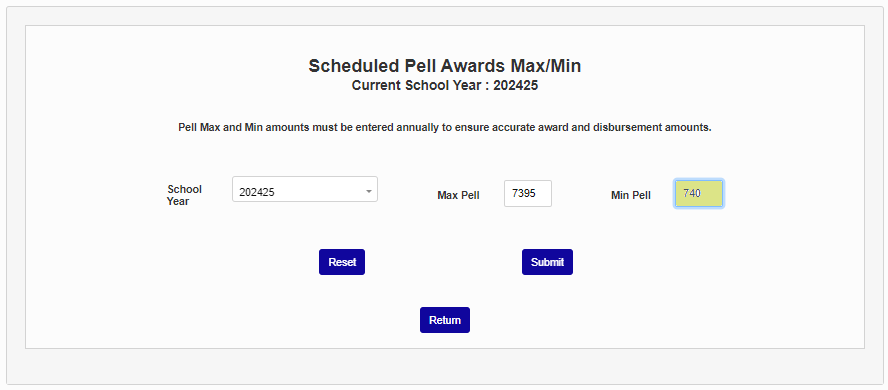
Beginning with 2024-2025 Pell processing, administrators are required to annually track and enter the published maximum and minimum Pell amounts in SONIS. The amounts must be entered in the Pell Max/Min link on the Pell Award Code record. From the Pell Max/Min link, annual amounts can be added or edited, and historical data can be viewed. Previous year records cannot be edited to maintain historical data and accuracy. Click Add to begin.
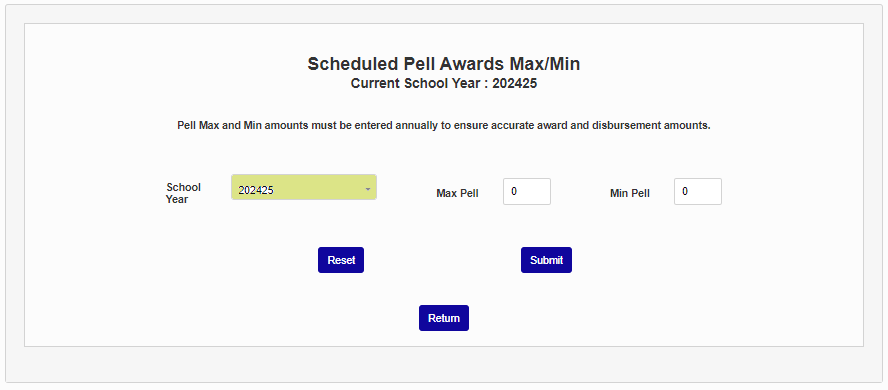
Enter the School Year, Max Pell, and Min Pell amounts.
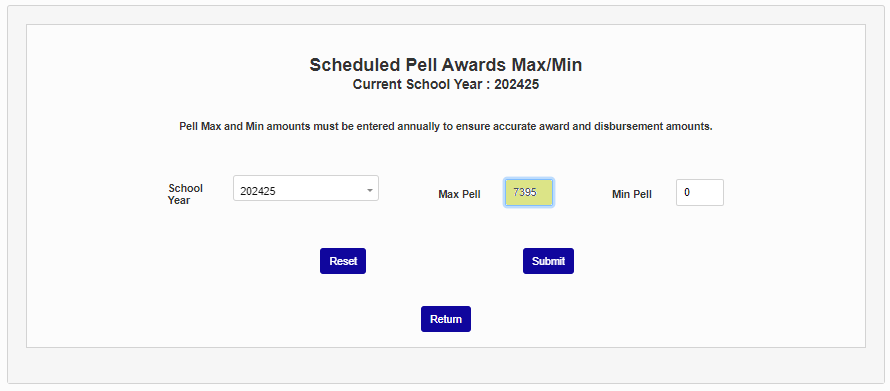
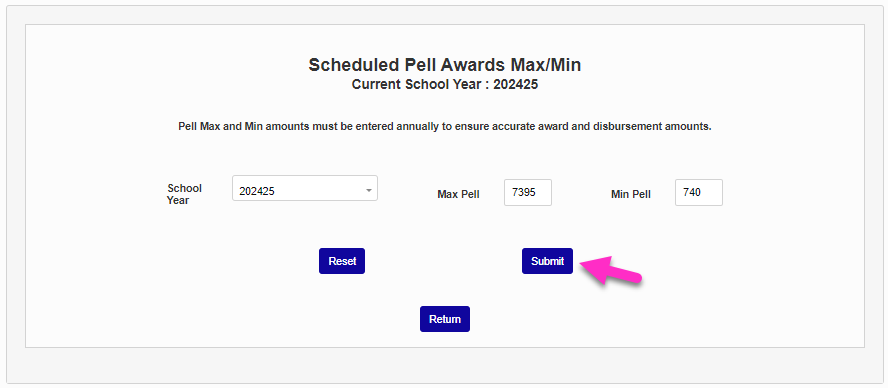
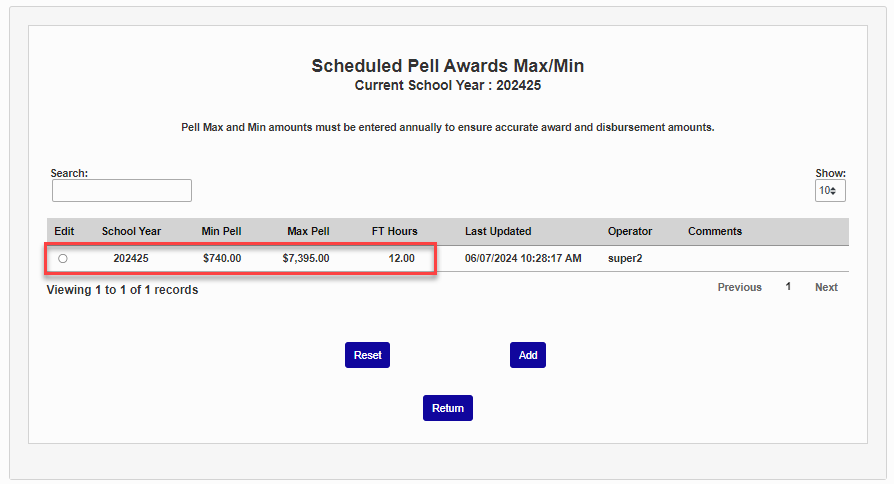
Submit to save the entered information. When a record is added or updated, the FT Hours field will be populated from the Enrollment Status table. Full-time hours will only be updated when the school year is greater than or equal to the current school year as defined in System Variables.
Post Transactions & Pell
If a Max/Min Pell record exists for a Pell award year, administrators are able to view the pre-calculated Pell amounts for students when using Post Transactions and Post Transactions by List.
If no Pell Max/Min values have been defined for a school year and the administrator attempts to post transactions, an error message will display.
When the Pell Max/Min values are defined and administrators successfully post transactions, the same criteria and calculations outlined above are used do determine disbursement amounts.