GL Accounts
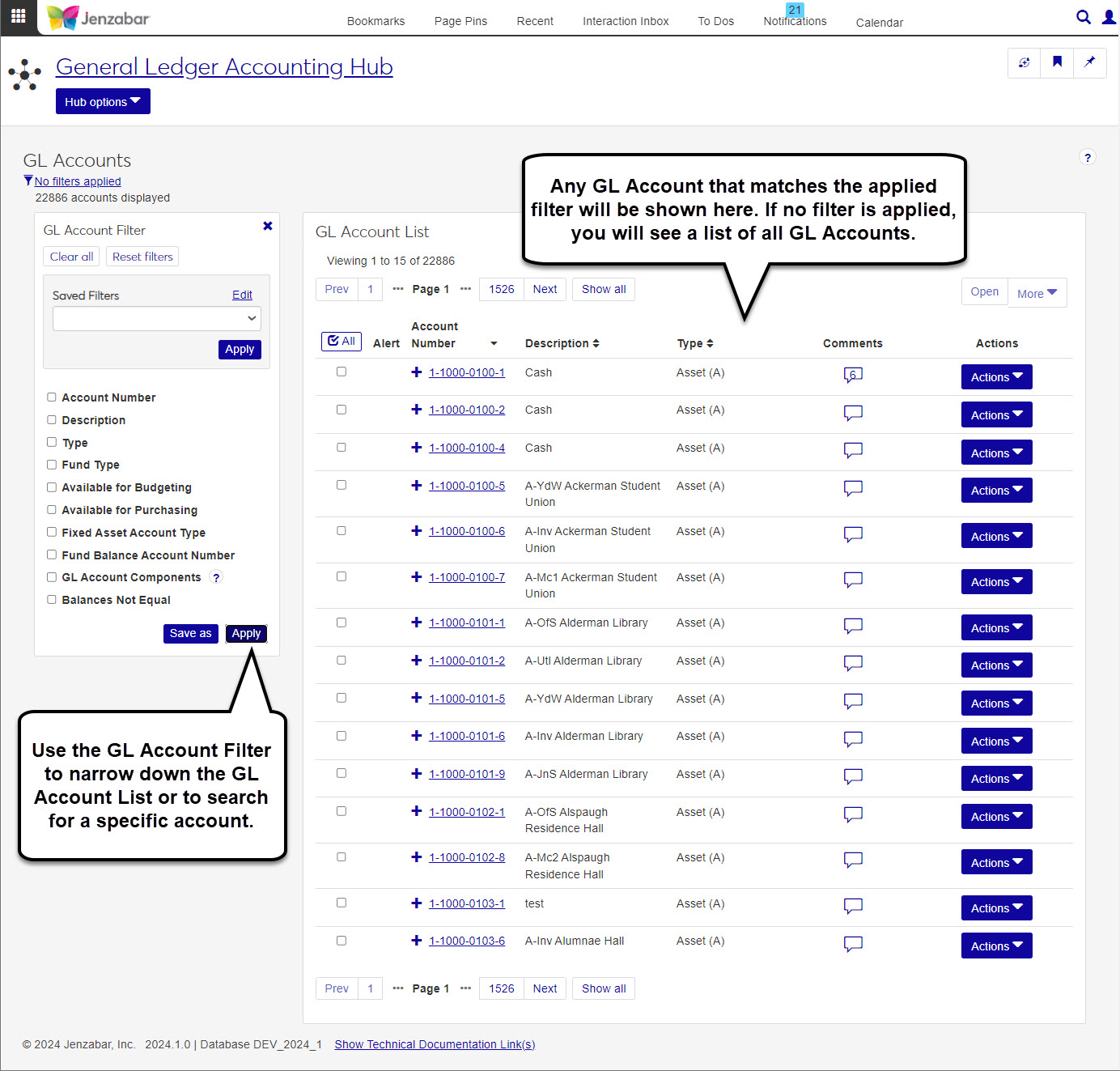
Every aspect of a General Ledger relates to accounts. The GL Accounts page allows you to search, edit, and create accounts.
 |
To work with GL Accounts, users will need to be assigned to a role with some combination of the following permissions:
Role | Role Permissions |
|---|---|
General Ledger Accounting GL Account Alternate Code Access > GL Account Management | Can view GL accounts Can edit GL accounts Can create GL accounts Can delete GL accounts Can download to Excel |
Account Number
Description
Type
Fund Type
Available for Budgeting
Available for Purchasing
Fixed Asset Account Type
Fund Balance Account Number
GL Account Components
Balances Not Equal
The GL Account List page allows you to view and manage all the accounts you have permission to access.
All accounts are associated with an Account Type, which is assigned based on the purpose of the account. Using account types allows the system to calculate the fund balances and assets so they can be summarized in the income statements and balance sheets.
Balance Sheet: Assets = Liabilities + Fund Balances
Income Statements: Fund Balances = Income - Expenses + Auxiliary
Code | Description | Type |
|---|---|---|
A | Assets | Balance Sheet |
L | Liabilities | Balance Sheet |
F | Fund Balances | Balance Sheet |
M | Not Active | Balance Sheet |
I | Income | Income Statement |
E | Expenses | Income Statement |
X | Auxiliary | Income Statement |
N | Not Active | Income Statement |
How To
This can be useful when you're creating a few accounts. You can enter account information directly or paste GL account information into the system from an external source like Microsoft Excel or Google Sheets.
Navigate to the Create GL accounts page. From this page, use the 4-step wizard to create new GL accounts.
Tip
At any point in the wizard process, you can click the Save and Finish Later button to pause work on the GL Accounts. You will need to enter a name for the save so you can access your progress when you can return. Your progress save will be available for up to 30 days, and can be accessed from the main Create GL Accounts wizard by selecting the Continue Where You Left Off option on Step One.
STEP ONE: How to Create GL Accounts
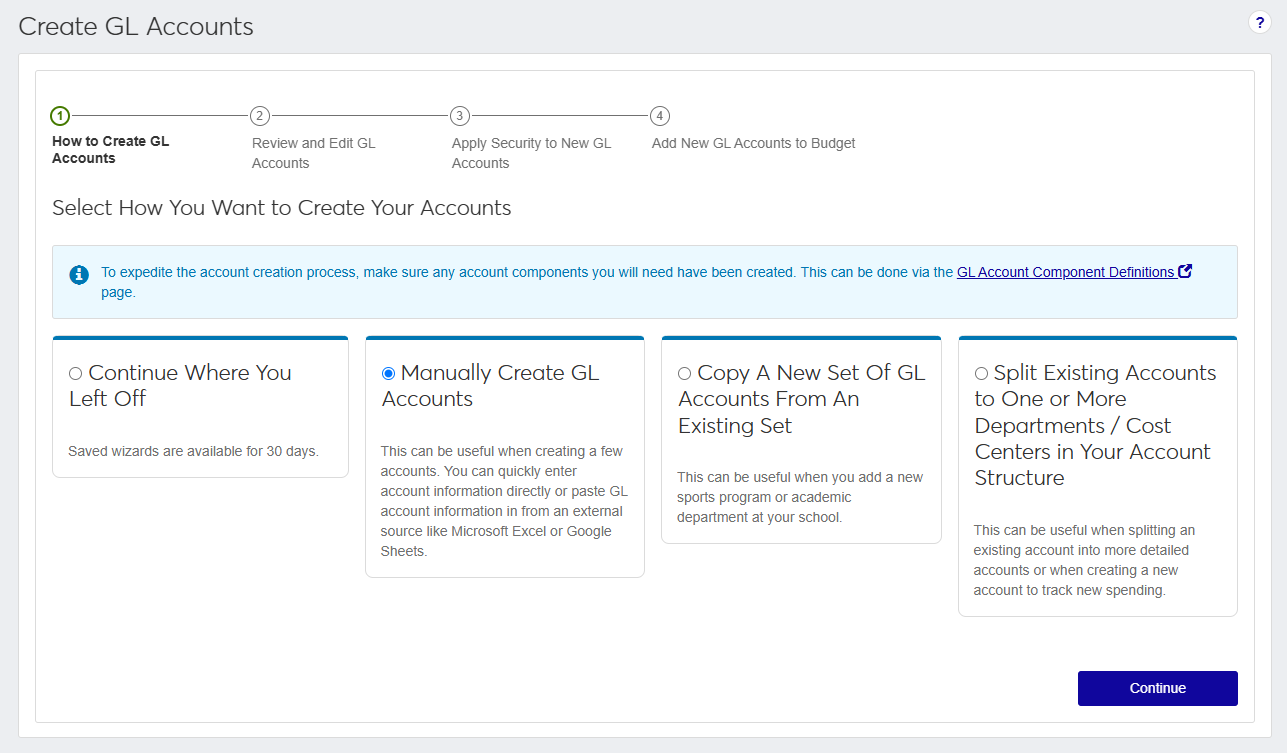
Select Manually Create GL Accounts button.
Click Continue.
STEP TWO: Review and Edit GL Accounts
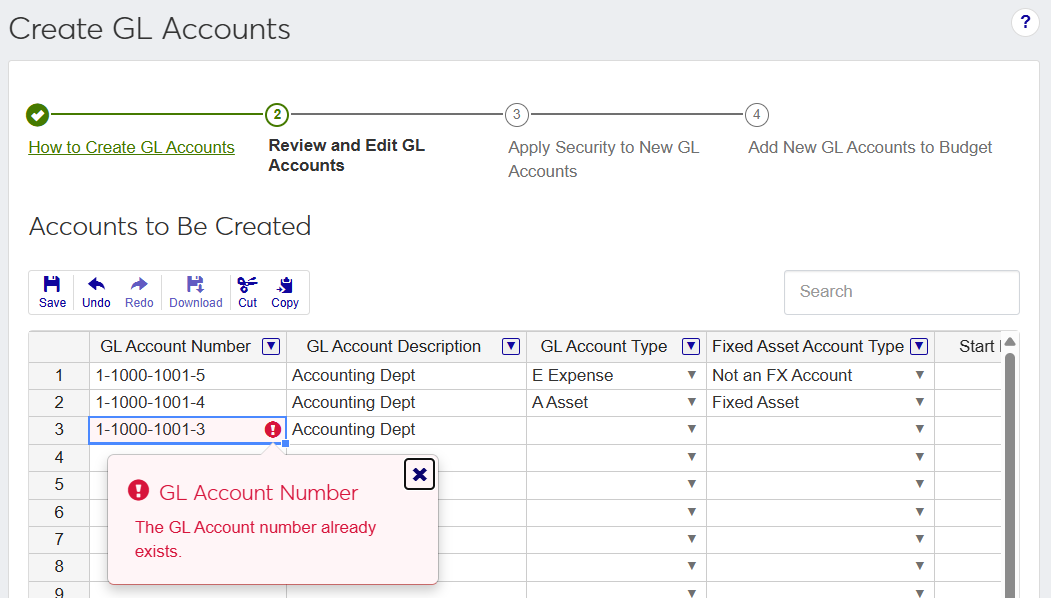
This step is where you'll add, review, and edit GL accounts by entering the new account information into the spreadsheet.
There are two ways you can add accounts to the spreadsheet:
Type the account information directly into the spreadsheet.
Paste from Excel (using Ctrl + C and Ctrl + V).
Verify the account information.
Click the Save icon
 in the upper left corner of the worksheet to see if there are any errors or warnings that appear for the newly entered rows.
Click Save and continue.
STEP THREE: Apply Security to New GL Accounts
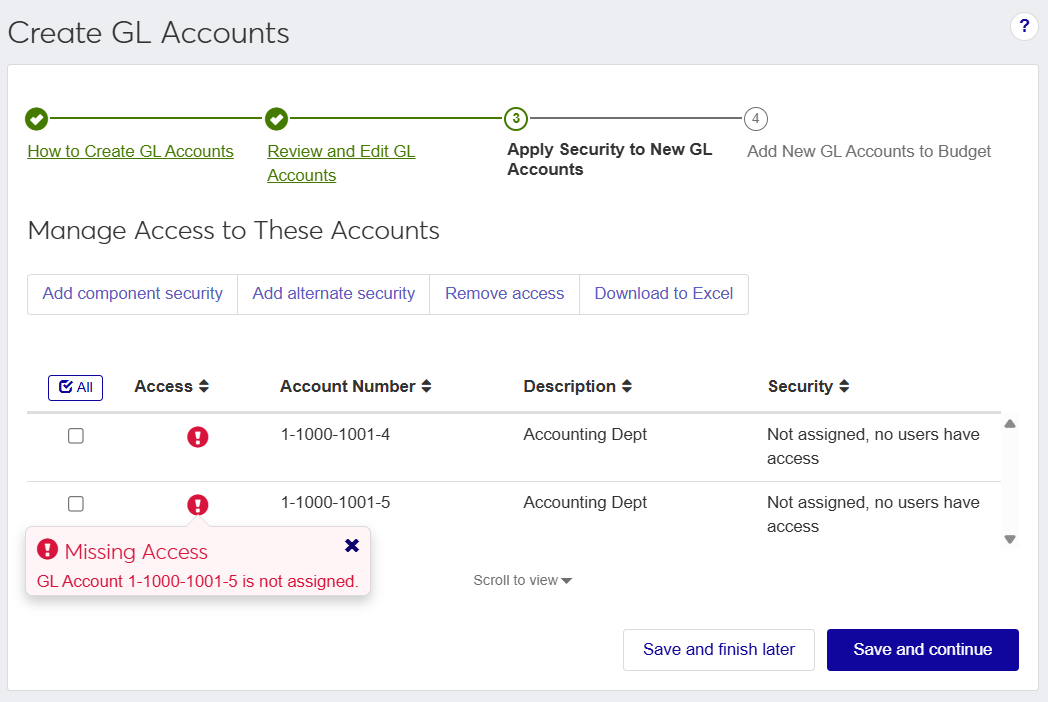
From this step, you can select roles and components to manage the accounts.
When this section opens, you will notice that the accounts are labeled with a warning icon
 and under the Security column is the "Not assigned, no users have access" message, which means you need to choose who will be able to access the accounts being added.
Using the checkboxes next to the accounts and the Add component security or Add alternate security buttons, you can quickly assign users to the accounts.
Component Security: allows you to select predefined roles giving permission to any user assigned to the role access to the selected accounts.
Alternate Security: allows you to select a predefined security code that will provide users assigned to that code access to selected accounts.
Click Save and continue.
STEP FOUR: Add New GL Accounts to Budget
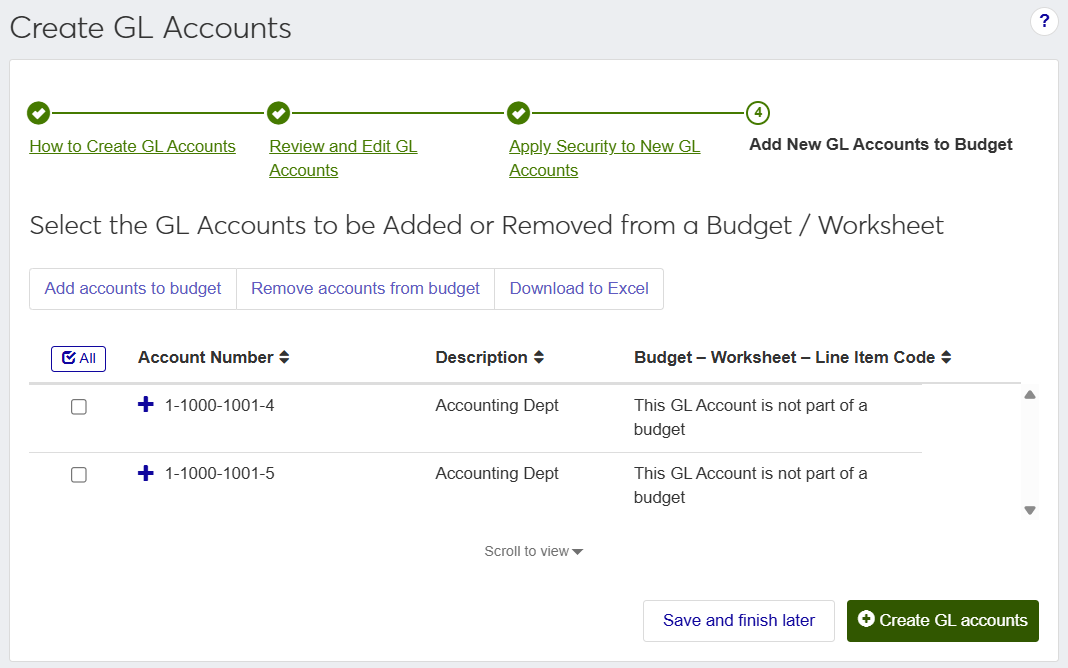
In this step, if any of the new accounts need to be part of a budget, you can use the checkboxes and the Add accounts to budget button.
Once you have all the new accounts added, verified, secured, and applied, you can click the Create GL accounts button. After a quick pause to make sure you want to complete the process, you will be redirected to the GL Account List page.
While you have the best intentions, occasionally you'll need to take a break or end for the day. In the Create GL Accounts wizard, when you use the Save and Finish Later option at the bottom of any step, you will be asked to name the save and you can refer back to it at a later time. These saves allow you to pick up where you left off in a previous session.
Open the Create GL Accounts wizard.
Select the Continue where you left off option.
In the Select Saved Create GL Account Wizard drop-down, choose the saved version you want to continue working on.
Warning
You can return to a saved wizard session for up to 30 days. After 30 days your save will be removed and you'll need to start over with the Manually Create GL Accounts option.
The wizard will open to step where you left off, and you can continue working with the wizard steps to completion.
The purpose of this feature is to provide users with a streamlined and flexible method for creating new GL accounts by copying an existing set of accounts tied to a specific department, cost center, or other account component. You can begin the process, pause and save you progress, and return later to finish creating the new accounts. As part of the copying process, you'll select a source account structure, define new account component values, review a preview of the generated accounts, update account attributes, apply security, and optionally add accounts to budgets before final creation.
Navigate to the Create GL accounts page. From this page, use the 4-step wizard to create new GL accounts.
Tip
At any point in the wizard process, you can click the Save and Finish Later button to pause work on the GL Accounts. You will need to enter a name for the save so you can access your progress when you can return. Your progress save will be available for up to 30 days, and can be accessed from the main Create GL Accounts wizard by selecting the Continue Where You Left Off option on Step One.
STEP ONE: How to Create GL Accounts
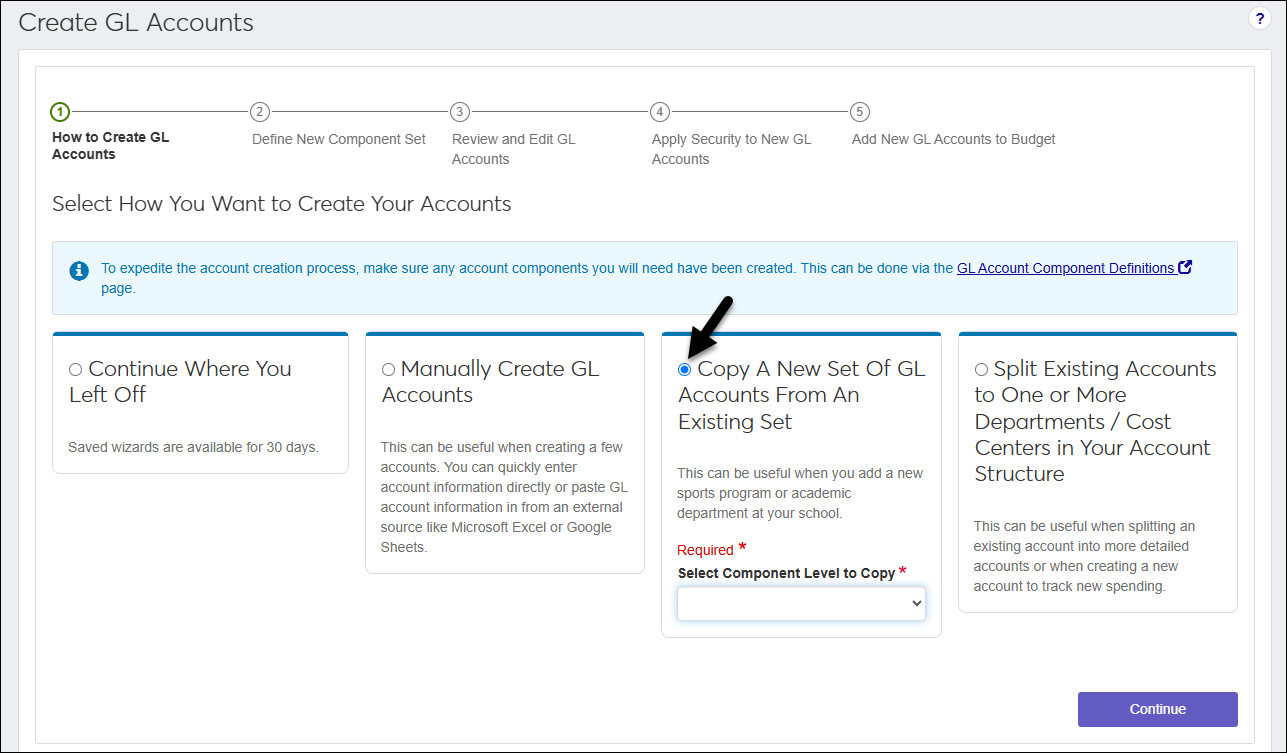
Select the Copy a New Set of GL Accounts From an Existing Set button.
Select an existing Component Level to copy.
Select an existing Code to copy. This list will vary depending on which component level you selected.
Click Continue.
STEP TWO: Define New Component Set
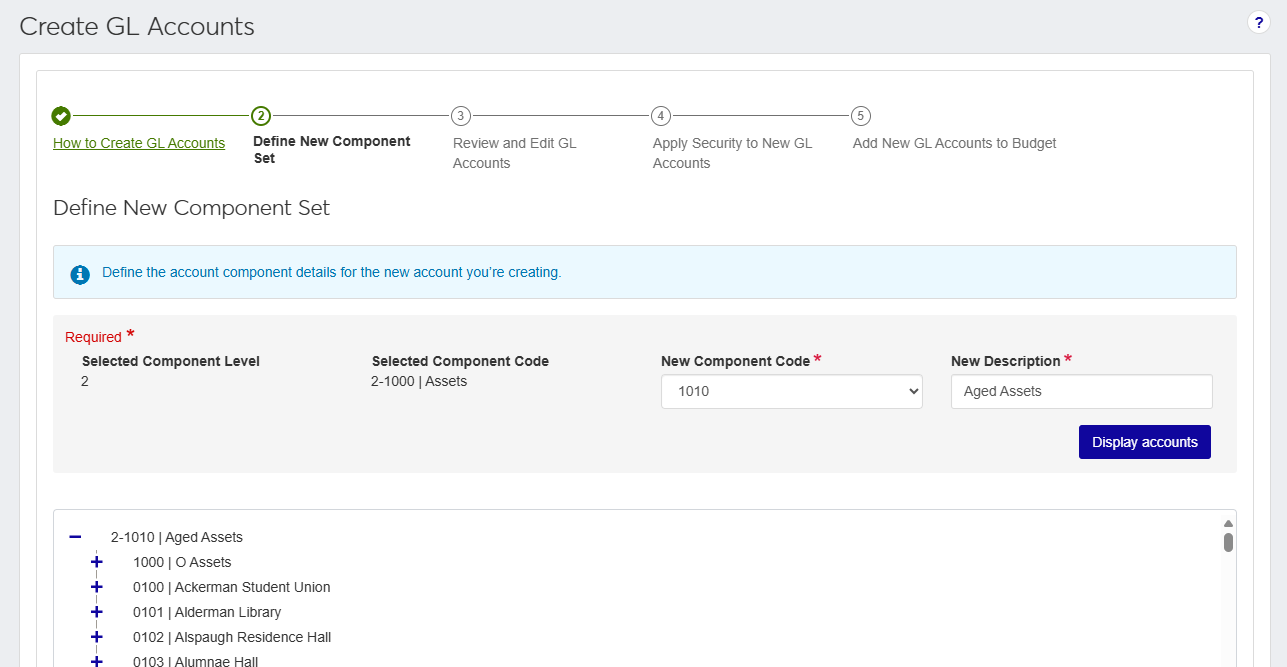
Select a New Component Code. The contents of this drop-down menu will vary depending on previous selections.
Select a New Component Code from the drop-down menu. These options are also dependent on your previous selections.
Enter a name for the new component you're creating in the New Description field.
Click Display Accounts. The box will update to display all the accounts that are being copied. You can the plus
 icon to expand any account and view the sub-accounts.
Click the Continue button.
STEP THREE: Review and Edit GL Accounts
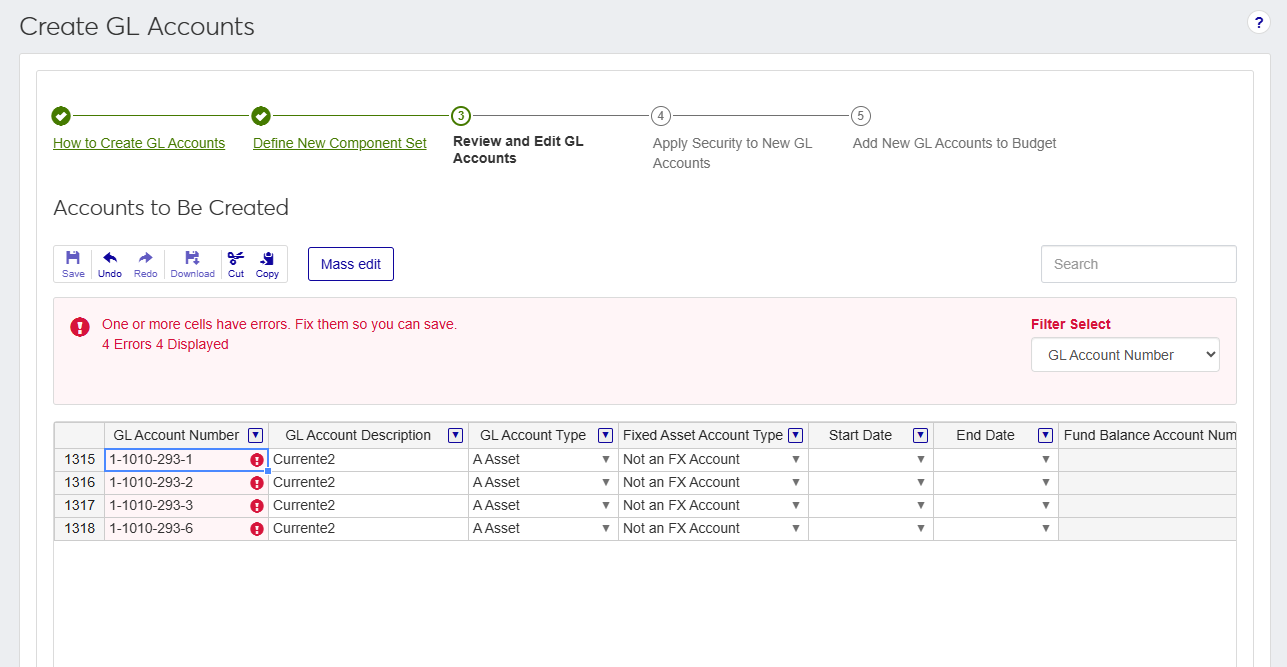
This step is where you'll add, review, and edit GL accounts by entering the new account information into the spreadsheet.
There are two ways you can add accounts to the spreadsheet:
Type the account information directly into the spreadsheet.
Paste from Excel (using Ctrl + C and Ctrl + V).
Verify the account information.
Click the Save icon
in the upper left corner of the worksheet to see if there are any errors or warnings that appear for the newly entered rows.Warning
If any of the account data you're copying has errors, these errors will need to be addressed before you continue. Use the Filter Select menu to display only rows with errors. Make the necessary changes to correct these errors before attempting to continue.
Tip
Use the Mass Edit button to make changes to multiple rows simeltaneously.
Click Save and continue.
STEP THREE: Apply Security to New GL Accounts
From this step, you can select roles and components to manage the accounts.
When this section opens, you will notice that the accounts are labeled with a warning icon
and under the Security column is the "Not assigned, no users have access" message, which means you need to choose who will be able to access the accounts being added.Using the checkboxes next to the accounts and the Add component security or Add alternate security buttons, you can quickly assign users to the accounts.
Component Security: allows you to select predefined roles giving permission to any user assigned to the role access to the selected accounts.
Alternate Security: allows you to select a predefined security code that will provide users assigned to that code access to selected accounts.
Click Save and continue.
STEP FOUR: Add New GL Accounts to Budget
In this step, if any of the new accounts need to be part of a budget, you can use the checkboxes and the Add accounts to budget button.
Once you have all the new accounts added, verified, secured, and applied, you can click the Create GL accounts button. After a quick pause to make sure you want to complete the process, you will be redirected to the GL Account List page.
Users with the necessary permissions can add and edit user-defined fields that allow you to track records, build forms, customize reports, and track other unique information not captured by the standard fields. User-defined fields are managed by the System Administrator, but other users can edit them.
To configure or edit user-defined fields, the "Can configure user-defined fields" permission must be enabled in the Campus-wide Definitions Only School Definitions role.
Note
User-defined fields are configured in the Campus-wide Definitions Hub. To access the hub from the main navigation menu, select Core > Campus-wide Definitions > User-Defined Fields. From there, click Configure for the relevant row.
To learn how to configure user-defined fields, see User Defined Fields.
Select User-Defined Fields from the Actions drop-down menu for the relevant definition. The User-Defined Fields window opens.
Edit the existing user-defined fields as necessary.
When you are done, click Save.
Select the checkboxes next to the rows you want to export.
From the Options drop-down, select Download to Excel. The Download to Excel pop-up opens.
Select options for the Excel format and data columns.
Click Download. Your .xlsx or .zip file is saved in the file location that you have set in your browser settings.